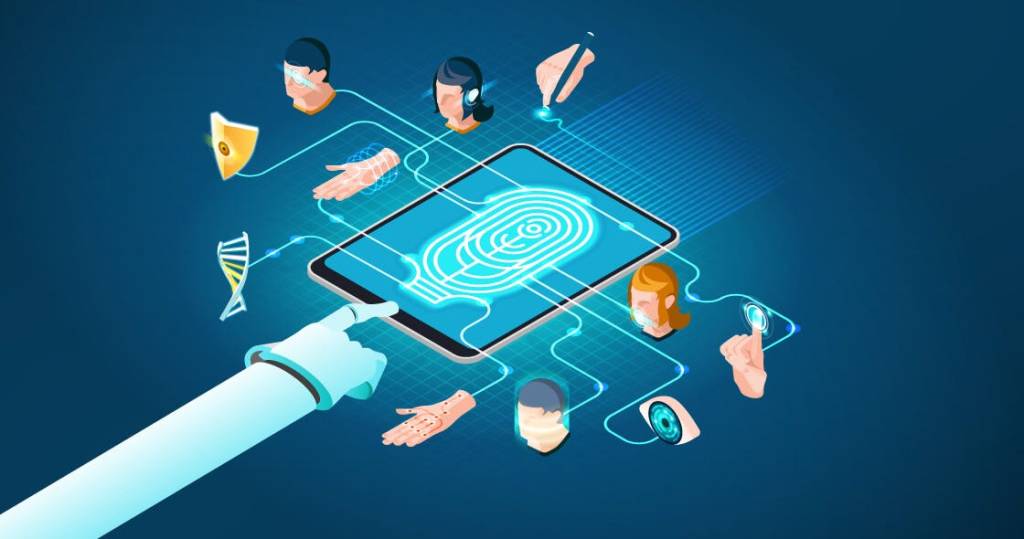
There are different biometric solutions that can be used to protect an organization’s server and/or sensitive device storage rooms. They can also be used to prevent unauthorized access to a building, giving added layers of security. Different options will be explained along with their benefits and caveats followed by a summary that will include two recommendations. Not all options work for every organization, so be sure to consider your needs as you see fit for your situation.
Fingerprint Scanner
These scanners provide a good alternative to the traditional types of authentication. They are accurate, with the failure rate being as low as 0.1% according to certain manufacturers. A convenient solution that only requires a second to work and eliminates the possibility of forgetting a badge or fob. It is a secure identification method because no fingerprints are the same and the scanners are made to be durable and withstand vigorous use. They are cost effective and can be used indoors or outdoors with touchless options available. The downsides are their susceptibility to spoofing using a high-quality fingerprint replica, the possibility of failure due to dirty scanners or worn fingerprints, and the concern of user privacy because the data stored can be used for tracking and identity theft.
Facial Recognition
Known for high-speed accuracy and reliability, it is ideal for quick identification to maintain security. It reduces the risk of identity theft and fraud. It is expedient and efficient and can run offline, not requiring an internet connection. Not requiring physical contact is an advantage this biometric provides over other types of security. Personalization is also an option that allows for an environment to be set up according to the user recognized, adding elements that create a positive user experience. Concerns about the system begin with privacy, the data collected from the user is significant and needs to be secure. The system can also encounter issues with changes in lighting, angles, and facial expressions. Criticisms have been made that the system can be racial, and gender biased. Spoofing is possible and has been proven successful.
Palm Vein Technology
This biometric is highly secure. It uses hidden features in the palm making it hard to replicate. Because the factors used are internal and unaffected by outside changes to the skin, only a single registration is required for life. This contributes to its being highly accurate and reliable, reducing the number of false rejections. Contact is not needed for the scanner to recognize the vein pattern. It is an expensive technology and can be difficult to implement with existing systems. The typical risks exist with storage of user data, and it should be encrypted. Health factors such as a fever can alter the appearance of the image and conflict with the stored data. There is also some dependency on infrastructure and environmental conditions which place limitations on its scalability.
Iris Recognition
It is often considered the most secure biometric because of the uniqueness and stability of iris patterns. The patterns are difficult to replicate, and the technology is resistant to many spoofing attacks. It has a minimal rate of false rejections and acceptance, and only requires a few seconds to authenticate, making it quick and easy to use. It is also contactless making it non-invasive. It is a costly system requiring implementation of hardware and software. An environmental constraint is lighting, affecting the collected data or verification if the lighting differs in brightness. As always privacy and security of the stored biometric data is an important issue and may cause some reluctance in acceptance by users due to the nature of the data being stored.
Summary
The two options that stand out the most are fingerprint scanners and facial recognition. These would be the easiest to implement right away because of their compatibility and cost effectiveness. These can be used in addition to other layers of security to protect the entrance of buildings and individual rooms. The fingerprint scanner gives you a good option to use outdoors where necessary and facial recognition gives you the ability to authenticate users remotely if required. These are also very common technologies that are commonly used by users already on their cell phones, so reluctance and resistance to their enactment should be minimal.
 JORGE DIAZ